.svg)
Ab Astra: Seeing what the Earth hides
.jpg)
There is a problem at the heart of critical minerals mining that rarely gets named directly. It is not access to reserves, the problem is information. The world holds significant deposits of lithium, copper, uranium, and rare earth elements, but every time a mining operator decides where to drill, how to model a salar, or how to estimate the continuity of a mineralized body, they are making a high-stakes decision on incomplete data. The subsurface has always been, in large part, opaque.
Ab Astra was built to change that.
The technology that sees through rock
The company uses muography, a technique that harnesses naturally occurring cosmic-ray muons to image the interior of large geological structures, to generate high-definition models of what lies underground. Muons are subatomic particles produced continuously as cosmic radiation interacts with the atmosphere. They penetrate matter at depth, and the way they attenuate through rock reveals density contrasts that translate into precise, three-dimensional maps of the subsurface. The technology integrates into existing drill holes, requiring only that a sensor be lowered down, and it is dramatically more efficient than conventional drilling-based exploration. No artificial radiation source. A genuinely non-invasive technology that sees what conventional methods cannot.
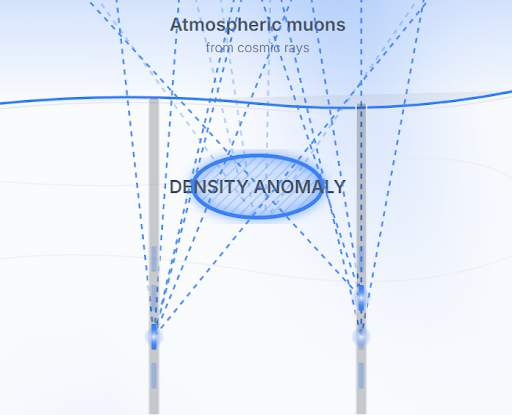
What makes Ab Astra's platform technically distinct is not the physics -muography as a concept has existed for decades- but the engineering built around it. Each proprietary sensor array can cover a radius of up to 1,000 meters and feeds data into LUMINA, an AI-powered platform for 3D and 4D subsurface interpretation. The result is spatial resolution up to one hundred times higher than comparable existing methods, combined with a monitoring capability that does not produce a single static image, but a live, evolving model of subsurface dynamics over time. In lithium brine operations, where aquifers shift and brine bodies move, that distinction between a snapshot and a continuous data stream is the difference between guessing and knowing.
Germán Serrano and Hernán Asorey met as doctoral students at the Instituto Balseiro. Hernán built his career in high-energy physics and particle detection. Germán took a different path, applied science for industry, most recently as director of special projects at YPF, Argentina’s largest oil and gas company, where he built a network across the mining, oil, gas, and energy sectors through years of operational work. They incorporated Ab Astra in December 2024, and the company already has offices in Neuquén, Buenos Aires, Madrid, Copenhagen, and Texas. Globally, only a handful of companies are working on muography at this level of technical depth. Ab Astra is one of them. That is not a marketing claim. It is a structural reality.
.png)
The market behind the thesis
The global energy transition is compressing timelines for critical mineral development, and the demand for better subsurface intelligence is a global one, spanning every region where lithium, copper, uranium, and rare earth elements are extracted. At the same time, the pressure on mining operators to produce with greater precision, lower environmental impact, and stronger community relations is only intensifying. A technology that reduces exploration capital expenditure, accelerates investment decisions, and enables 4D monitoring of aquifers and hydric resources is not a complementary tool. For serious operators, it becomes infrastructure.
It is not a coincidence that this platform emerges from Argentina. The country's deep tradition in physics, anchored by institutions like the Instituto Balseiro, has produced generations of world-class scientists. What Ab Astra represents is that talent finding its way into a company built for the global market.
Critical minerals are discussed endlessly in terms of geopolitics and reserves. Almost never in terms of the information layer that makes those reserves genuinely exploitable. That layer, the ability to see clearly, model accurately, and monitor continuously, is what Ab Astra is building.
Why we invested
We began conversations with Germán and Hernán in the second half of last year. Over December and January, we spent time with the founders, getting deep into the technology, the market, and their ability to execute. That process gave us the conviction to invest and to lead the round. Just before closing, we spent more time with Germán at our annual summit in San Francisco with Tim Draper, which only reinforced what we had already seen.
What struck us from the start was not only the technology, which is genuinely difficult to replicate, but the clarity with which Germán understood the market he was entering. He knew the mining industry from the inside. He understood what operators actually need when they make capital-intensive decisions about where and how to extract. And he had the intellectual rigor of someone who had spent years inside one of Latin America's most demanding scientific institutions.
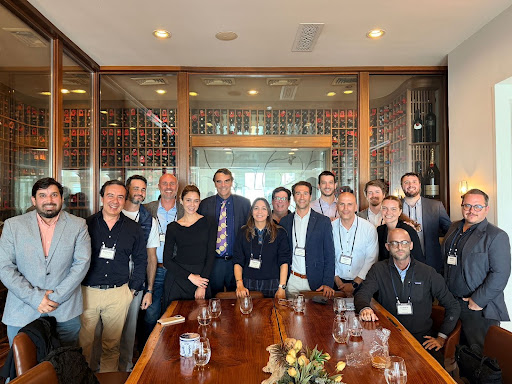
That combination, deep technical credibility and real industrial experience, is rare at pre-seed stage. It is also precisely what a company like this needs to convert a physics breakthrough into a commercial platform.
We led Ab Astra's $2M pre-seed round. The capital will be used to build the first muography instrument designed specifically for mining applications and to execute the first proof-of-concept deployments in a salar. The company moves from laboratory validation to field performance.
Argentina has a history of producing exceptional scientists. What is changing now is the number of those scientists who are choosing to build companies. Germán and Hernán are part of that shift and we are glad to be walking this road with them.