.svg)
SEMQ: Rethinking the foundation layer of machine intelligence
.png)
There is a cost inside every modern AI system that rarely gets discussed outside engineering teams: the cost of representing meaning itself.
Every time a model processes language, code, or images, it translates that information into an embedding: a high-dimensional numeric representation that allows machines to compare, search, retrieve, and reason over meaning. Embeddings sit underneath search, recommendation systems, retrieval pipelines, agent memory, and many of the large language model applications now moving into production.
But as AI systems become larger, more persistent, and more widely deployed, the limitations of that representation layer are becoming harder to ignore. Vectors are expensive to store, difficult to keep stable across model versions, and vulnerable to degradation as systems operate over time.
Most of the industry has focused on optimizing around those constraints. SEMQ is asking a more fundamental question: what if the representation itself needs to change?
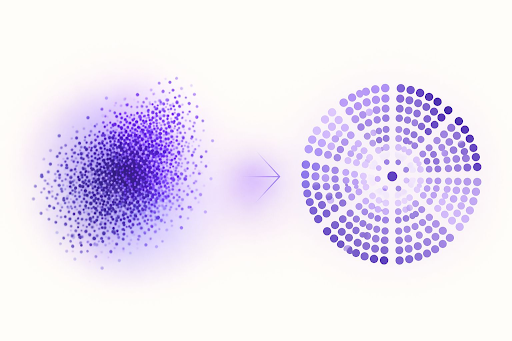
SEMQ’s approach replaces continuous vector embeddings with symbolic, discrete representations, a shift that makes meaning both compressible and structurally stable.
Internal testing has shown compression of up to 5.33x, reducing the storage and computational burden of embedding-based systems. The benefits, however, extend beyond efficiency. Because these representations are symbolic and reproducible by design, they can also reduce variability in AI systems operating over extended periods.
In the company’s early benchmarks, SEMQ’s representation showed a 438.7% improvement in resistance to semantic drift compared with a continuous baseline.
That matters because the next phase of AI will not be defined only by larger models. It will depend on systems that can remain stable, reproducible, and cost-efficient over time.
From a classroom observation to a company
Founder and CEO Andrés Mac Allister did not arrive at this architecture through a straight line.
The idea behind SEMQ began more than fifteen years ago, during an algebra class at the Universidad Nacional de Rosario. In 2010, Mac Allister noticed a property inside vectors that appeared mathematically relevant. His professor confirmed the observation, but told him it had no practical use. So he set it aside.
It would take fifteen years to prove otherwise.
In the years that followed, Mac Allister built software and hardware projects across telemedicine and agtech. Yet the same problem kept resurfacing: as systems became more data-intensive, the cost of operating vector databases and semantic search infrastructure grew faster than the businesses built on top of them.
That led him back to his original observation. What had once seemed like a mathematical curiosity became a working hypothesis, then a patent, and eventually SEMQ.
.png)
Why we invested
Draper Cygnus is leading SEMQ’s pre seed round. Mac Allister is currently in Silicon Valley through a program at Draper University, presenting the technology to investors, mentors, and founders in one of the environments where the next generation of AI infrastructure companies is being shaped.
Our thesis is clear: the most important opportunities in deep tech often emerge where a structural bottleneck meets a defensible technical edge.
Embeddings sit underneath almost every AI system in production today. That means a real improvement at this layer does not solve a niche problem. It compounds across the entire stack above it: cheaper storage, more efficient retrieval, more stable agent memory, lower energy consumption, and the possibility of running meaningful AI on smaller devices at the edge.
Much of the current work in AI infrastructure is focused on making existing systems faster, cheaper, or easier to scale. SEMQ takes a more fundamental approach by questioning the underlying representation itself. That is precisely the kind of technical ambition we look for.
SEMQ is still at an early stage. Its near-term focus is scientific validation and product development, beginning with an open-source layer for developers and moving toward enterprise deployments that do not depend on cloud infrastructure.
But the ambition is significant: to become a new standard for how embeddings are represented across the industry.
Why it matters now
AI’s current trajectory is linear in the most expensive way: more intelligence requires more data centers, more energy, more storage, and more physical infrastructure. That path has no obvious ceiling.
Technologies that reduce the footprint of AI without reducing its capabilities are not just efficiency tools. They are becoming necessary infrastructure.
SEMQ addresses that challenge at a layer many teams have optimized, but few have fundamentally rethought: how meaning itself is represented.
That is why we invested.