.svg)
Why We Believe in Eywa

For years, psilocybin lived in the shadows. It was the kind of molecule people whispered about, wrapped in stigma and misunderstanding. But behind that taboo, there was always something more: a compound capable of altering perception and, in the right hands, helping us rethink the human mind itself. Today, decades later, psilocybin is back in the spotlight. Not as folklore, but as science. And the plot twist is that the next chapter is being written in Montevideo.
That is where Eywa Biotech begins. A young company founded in 2022 by Victoria Costa Paz and Paola Rodríguez Camarot, built on the simple but ambitious idea that mental health deserves better tools. With their blend of synthetic biology and genetic engineering, they found a way to produce pharmaceutical-grade psilocybin and other psychedelic molecules at a fraction of the cost and time of traditional methods. And they are doing it with a rare advantage: the ability to deliver the cost and scale of fully synthetic manufacturing while still qualifying as natural-origin biosynthesis. That duality is powerful, and very few can claim it.
Eywa is building something the industry urgently needs: the manufacturing layer that has been missing in the rise of psychedelic therapy. Their platform removes three chemical steps, reduces waste by 90 percent, and cuts production costs to levels the sector has not seen before. The market has already taken notice. Seven letters of intent from pharmaceutical companies and research centers across Latin America, Europe, and Australia confirm that demand is real and growing. Global supply of psilocybin remains limited, and Eywa is stepping into a strategic position in a field projected to grow more than 13 percent annually and reach 10 to 50 billion dollars by 2030.
The premise behind Eywa is straightforward. If the therapeutic potential of psychedelic molecules is already well documented, then the bottleneck is manufacturing. What the world needs now is quality, safety, and scale. That is the gap Eywa intends to close.
The need could not be more urgent. According to the World Health Organization, one in four people in Latin America will experience a mental health disorder at some point. Anxiety, depression, and post-traumatic stress have become everyday words, yet the treatments available look almost identical to those of thirty years ago. “The last major breakthrough was Prozac”, Victoria often says. “We need treatments that change not only symptoms, but the way we understand the mind.”
The science is moving. Psilocybin and other psychedelic therapies continue to show promising results in clinical trials in the United States, Europe, and Australia. And the momentum is accelerating. ATAI Life Sciences recently shared new data on 5-MeO-DMT with rapid and durable effects. Compass Pathways earned Fast Track designation from the FDA as it completed recruitment for its Phase 3 COMP005 trial in treatment-resistant depression. And outside mental health, researchers in the aging field are uncovering early signs that psilocybin-related compounds may play a role in pathways linked to longevity. Regulators are already acting. In 2023, Australia approved the controlled use of psilocybin and MDMA for resistant depression and PTSD. The world is preparing itself. Now manufacturing must catch up.
This is where Eywa’s platform makes a difference. Their biosynthesis cycles run in one or two days instead of weeks or months, and at up to five times lower cost. In a domain where every milligram matters, that advantage becomes strategic. Letters of intent from partners across three continents suggest that commercial pull is already there.
Victoria’s path is not what most people expect from a biotech founder. She studied Communications at Universidad de San Andrés, worked on global campaigns for Fanta and Sprite at Coca-Cola, then moved to Santander. But it was during the pandemic, in a small apartment in Buenos Aires, that she reconnected with biology. What started as an interest in bioplastics became a bridge between science and market-ready solutions. “Academia produces incredible knowledge, but it often stays there,” she says. “My goal was to take those ideas into the world, where they can impact real people.”

Our story with Eywa began in late 2024, well before the public spotlight. We met Victoria and started a series of conversations that quickly went deeper than a pitch: manufacturing strategy, regulatory pathways, scientific validation, and the long term vision for building the missing production layer in psychedelic therapeutics.
By the time Victoria stepped onto the Meet the Drapers stage during Tim’s visit to Buenos Aires, we had already formed our conviction. The show was not the starting point of the relationship, but a moment where the science and the ambition were put in front of a global audience. After a deep due diligence process, we decided to co lead Eywa’s Seed round together with Draper Associates in June last year.
Fast forward to today. In the Season 9 finale, Eywa secured $750,000 in investment, $500,000 from Tim Draper and $250,000 from Adam Draper, after finishing in second place. For us, the outcome reinforced what we had seen from the beginning: a technically grounded team building the manufacturing layer this therapeutic field needs. We backed Eywa early because of the platform, the execution, and the founders’ ability to scale real science. The global visibility simply confirmed that signal.
In many ways, Eywa represents the mindset that moves us forward: founders who think like scientists and scientists who act like founders. People who understand that true innovation takes patience, validation, and scale, not hype.
With the capital raised, Eywa is preparing to scale its manufacturing capacity to 200 liters under GMP standards, optimize its genetic processes, secure new patents, and expand commercially across Latin America, the United States, Europe, and Australia. The roadmap is clear. First, supply pharmaceutical companies and research centers with clinical-grade compounds. Then evolve into a new kind of global pharma capable of producing accessible and meaningful mental health treatments.
But beyond the technology, the story of Eywa carries something bigger. It redefines the role Latin America can play in global scientific innovation. For decades, the region was seen as a market or a supplier. Now it is becoming a creator of applied science.
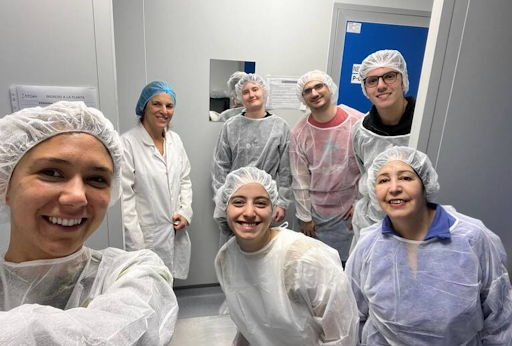
There is something symbolic about a startup dedicated to exploring the mind emerging from the south of the continent. Psilocybin, misunderstood for years, is returning as a therapeutic tool in a world searching for meaning, calm, and reconnection. Eywa is not just producing molecules. It is reconnecting science with empathy and proving that innovation can come from unexpected places. At a time when much of the technological frontier seems to orbit around chips and rockets, perhaps the next great revolution will come from somewhere else: the inside of the human mind.
And this time, from Latin America.